Why does meat sometimes appear rainbow-colored? (It's not broken: it's science!)

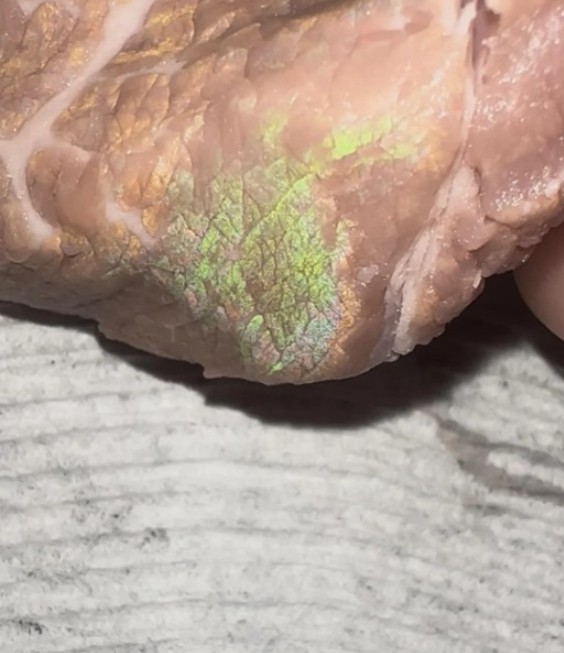
 Densely packed muscle fibers
Meat is made up of long, parallel strands of protein (similar to microscopic ropes).
When meat is sliced, especially thinly, these fibers are cut evenly, creating an almost perfectly smooth, grooved surface.
 The light enters the rhythm
When light falls on this finely cut surface:
It bounces on the tiny ridges between the fibers
The waves are bent and scattered: this phenomenon is called diffraction.
Different wavelengths (colors) refract at different angles
 Effect? A rainbow sheen that changes as the meat moves or the viewing angle changes.
 Does humidity make things worse (or better?)
A damp or slightly oily surface enhances this effect, acting like a lens that enhances the color.
 Fun fact: This phenomenon is more common with cured meats like roast beef, ham, turkey, and pastrami, because they are often sliced very thinly and have a soft texture.
 Is rainbow meat safe to eat?
Yes, in almost all cases.
If meat:
Normal odor (no sour or rotten odor)
It’s sticky but not slippery
Absence of mold or unusual colors (such as gray-green or black spots)
So this rainbow glow is a harmless law of physics, not a health hazard.
 You could compare it to the colors on a CD: fantastic, unexpected, but completely safe.
 When should you worry?
Rainbow shades are usually fine, but don’t ignore these warning signs:
Mucilaginous consistency
Bacterial Growth: It’s Time to Get Rid of It
Acidic, ammonia-like or sulfur-like odor
Corruption: Trust your nose
Gray, green, or blurry spots
Mold or advanced decay
Sticky or tacky consistency
Start of microbial activity
 If you notice any of these symptoms
For Complete Cooking STEPS Please Head On Over To Next Page Or Open button (>) and don’t forget to SHARE with your Facebook friends.